
Scaling a business is a delicate balancing act that requires not only robust products and solid market strategies but also a highly agile, top-tier team capable of executing at breakneck speed. Tech companies, especially scale-ups, operate in a hyper-competitive environment where first-mover advantage and swift innovation cycles can decide market winners. However, while products, services, and business models have evolved to meet modern demands, outdated hiring practices often lag, failing to leverage advanced sourcing platforms, global talent pools, and data-driven insights.
According to TestGorilla’s annual report, as of 2025, a significant majority of companies, more than half (53%), are still requiring degrees for roles, despite a growing shift towards skills-based hiring. While this marks progress (up from 30% just a year ago), it demonstrates how deeply entrenched traditional credential-focused hiring remains. Despite advances in technology and new talent sourcing avenues, many companies still rely on traditional hiring processes that are too slow, rigid, and inefficient. The result? Lost revenue, project delays, and burnout among existing teams.
Africa is home to some of the boldest, most driven talents in the world. Yet, these archaic hiring practices create a frustrating paradox for capable Africans eager to contribute but systematically locked out of opportunities because our hiring system hasn’t kept up. If you’re wondering why your business isn’t scaling as fast as you’d like, it may be time to assess how you’re building your team. In this blog, we’ll explore the key flaws of hiring and introduce cutting-edge hiring strategies to unlock faster, smarter, and better talent.
1. Seeking Candidates With a Perfect Skill Match
When reviewing résumés or conducting interviews, it’s important not to overlook candidates simply because they don’t check every single box on your list. While they may not have the exact skill set you’re seeking, many bring transferable skills, a strong willingness to learn, and the right mindset to grow into the role. Often, the most valuable team members are those who show initiative, adaptability, and a genuine desire to contribute. Hiring for potential, not just perfection, allows you to invest in people who are ready to rise to the challenge and grow with your organization.
2. Omitting Salary
Nothing frustrates talent more than going through rounds of interviews, only to find out at the very end that the pay doesn’t match their expectations. It’s a waste of time for them and for you as a hiring recruiter.
Often in interviews, candidates are asked, “What are your salary expectations?” One way this back-and-forth could be reduced is by including salary details directly in the job description. According to an insight from ACELR8, a LinkedIn poll run by their Head of Marketing showed that an overwhelming majority of 91% wanted to see salary information upfront in job postings.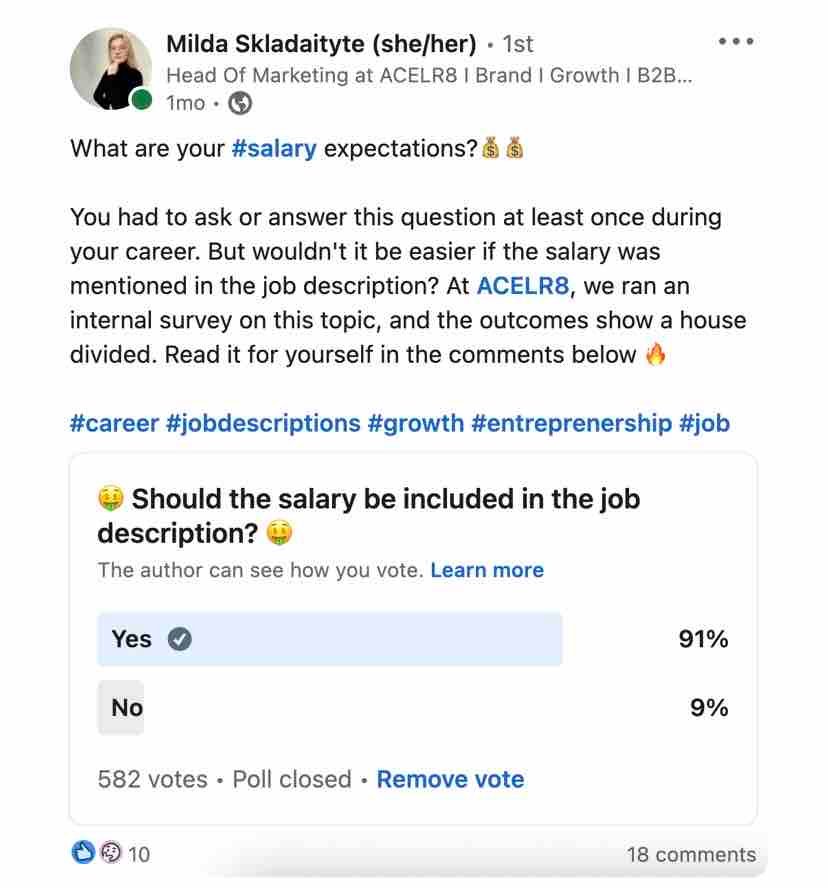
If a company isn’t upfront about pay, it often signals a less competitive offer or lack of internal transparency. By disclosing salary at the very beginning of the process, you start off on the right track. It builds trust, filters out mismatched expectations, and signals that your company values open and honest conversations from day one.
3. Relying on Traditional Interviews
Traditional interviews, where a candidate is asked a series of questions in a formal setting, have long been the standard in hiring. But while they may reveal how the applicant communicates or presents themselves, they often fall short in showing how well a person can actually do the job. Many great candidates may not excel at interviews, especially if they’re nervous or unfamiliar with the format, but that doesn’t mean they lack ability.
To get a clearer picture of a candidate’s true potential, it’s important that leaders shift from résumé-based hiring to skills-based hiring strategies. Leaders should begin utilizing assessment tools that evaluate relevant job skills and adaptability. A CV can tell you where someone has been, but it rarely shows where they can go. At Accretio, we lean on assessment tools that reveal real skills, adaptability, and problem-solving capacity.
When we needed a virtual assistant, instead of getting buried under piles of CVs, we used TestGorilla to assess practical skills. Interestingly, the candidate who stood out didn’t have the flashiest résumé. What she did have was adaptability, clarity, and initiative. Today, she isn’t just supporting operations; she’s thriving as our Operations Assistant, building meaningful relationships with clients and spotting high-potential talent that others might have overlooked.
4. Age-Based Hiring Bias
Including age preferences in job postings is not only outdated, it’s often illegal. Phrases like “young and energetic” or “must be under 35” are discriminatory practices. A meta-analysis of age bias in hiring found that applicants aged 40–49 had 11–50% lower odds of receiving callbacks compared to younger applicants (aged 29–35). It’s unfair and deeply limiting.
By sidelining people because of age, we miss out on real value from both ends of the experience spectrum. Leaders should hire for capability, not chronology. When you build teams that span generations, you create a richer, more balanced workforce. One that combines youthful experimentation with mature perspective, and that’s where innovation truly lives.
5. Ghosting Your Applicants
Job hunting is stressful enough without being met with silence. Yet in many hiring processes across Africa, candidates are left hanging—no feedback after interviews, no updates after assessments. It may seem harmless, but it damages your brand and discourages strong talent from ever applying again.
Clear, timely communication makes all the difference. Set process milestones, send updates, and always close the loop, especially for finalists. A simple, respectful rejection note shows that your company values people, not just positions.
A Framework to Future-Proof Your Hiring: The H.I.R.E. Model
To build a stronger, more inclusive hiring culture, African organizations need to rethink not just who they hire, but how. The H.I.R.E. model offers a fresh, people-first approach for doing that:
H – Humanize the process:
Hiring is a two-way relationship. Treat candidates with respect from start to finish. Keep communication open, honest, and timely.
I – Invest in skills-based evaluation:
Don’t rely on polished CVs or perfect interview performances alone. Look for what really matters. Use tasks, simulations, or case studies to assess skills that match the actual role, not just academic history or titles.
R – Reimagine your job descriptions:
Avoid rigid requirements. Describe the outcomes the role should achieve and the values that matter most, instead of focusing only on qualifications or years of experience. This opens the door to more diverse and capable candidates who might otherwise be overlooked.
E – Expand your definition of potential:
Potential doesn’t always come in the form of a perfect résumé. Look for people who are curious, eager to learn, and aligned with your mission.
Don’t Just Hire for Today. Build for Tomorrow.
Africa’s talent landscape is full of potential. But to tap into it, we have to let go of hiring habits that no longer serve us. That means looking beyond rigid checklists and leaning into more inclusive, thoughtful, and skills-driven approaches.
Let’s create room for the self-taught designer, the career shifter with drive, and the overlooked graduate with grit. Because talent doesn’t always look the way we expect, but they are there, waiting to be seen.
At Accretio Africa, we’re helping companies make this shift. We make the hiring process feel less like a maze and more like a conversation, matching you with competent, values-aligned talent from across the continent. Let’s help you build a team that works.